
Anchoring Bias in Trading: How to Overcome the “Invisible Enemy” of Funded Accounts
Lograr la rentabilidad en el trading fondeado requiere mucho más que una estrategia técnica sólida; exige un dominio absoluto de la psicología. Entre todos los obstáculos mentales, existe uno particularmente insidioso: el efecto de anclaje.
Si bien este sesgo cognitivo parece inofensivo en la teoría, en la práctica puede ser el motivo por el cual muchos traders fallan en sus objetivos de beneficio o exceden su drawdown máximo.
What is the anchoring effect and why does it affect your trading?
The anchoring effect occurs when our mind clings to the first piece of information it receives (the “anchor”) and uses it as an absolute reference point for all future decisions, ignoring the market’s evolution.
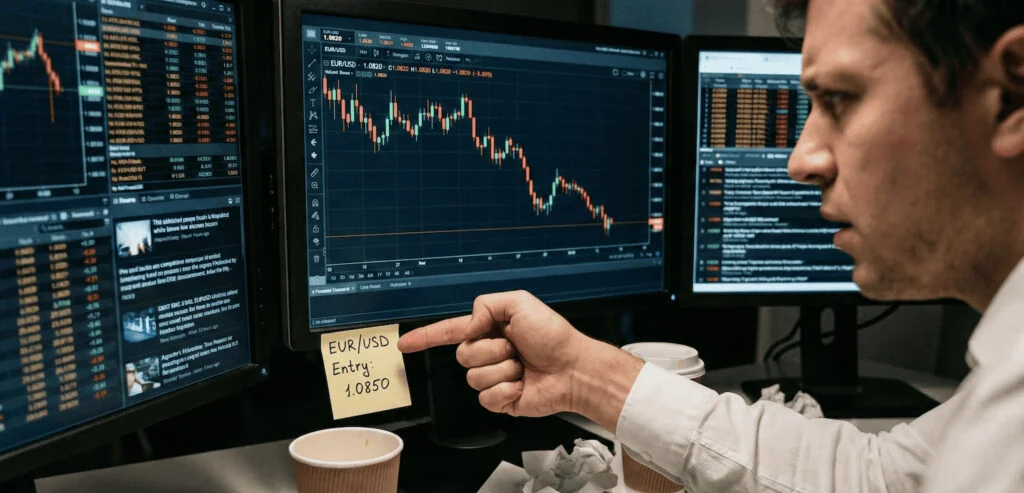
Real example in Prop Firms: Imagine you open a trade on the EUR/USD pair at 1.0850. The price drops to 1.0820. Your mind “anchors” to the initial entry price and resists closing the position with a small loss, irrationally waiting for the price to return to that point to “break even”.
In this scenario, you stop being an objective trader and become a hostage to your entry price—a figure that the market simply does not care about.
Common types of “anchors” in prop trading
Entry price: Judging the value of an asset based on where you entered rather than its current structure.
Third-party predictions: Anchoring to an analyst’s report or a tweet, even when price action demonstrates otherwise.
Irrelevant historical levels: Expecting an asset to reach a price just because “it was there before”, without considering the current macroeconomic context.
5 Practical strategies to mitigate anchoring in funded accounts
Recognising the bias is the first step, but to eradicate it you need a defence system. Here is a guide to effective trading strategies to protect your capital:
1. Trade the chart, not your P&L Keep your decisions based exclusively on updated technical and fundamental analysis. Ask yourself: “If I didn’t have this position open right now, would I enter at this level?”. If the answer is no, your anchor is winning.
2. Automate your exit (Stop-Loss and Take-Profit) Set rigid rules before entering the market. By using predefined levels according to your trading plan, you eliminate the temptation to “negotiate” with the anchor when price moves against you.
3. The “Invalid Thesis” rule Conduct constant reviews. If the conditions that led you to open the trade have changed, the position must be closed. In prop firm trading, preserving drawdown is more important than being right.
4. Avoid historical references without context Ensure you compare assets logically. Do not expect price to react the same way as it did a year ago if liquidity or interest rates are different.
5. Pre-session and post-session routines Discipline is not spontaneous; it is trained. Keeping a trading journal where you record why you entered and why you exited will help you identify anchoring patterns retrospectively so you don’t repeat them.
Strengthen your mindset with professional support
Trading is not just a battle against the charts; it is a battle against your own biases. At WSFunded, we understand that psychology is 80% of the success in a funding challenge. To help you navigate these pressures, we have exclusive resources:
- Psychofunding Sessions: Weekly meetings led by our psychologist Olga Paredes, focused on strengthening the trader’s resilience and discipline.
- Community and Support: Spaces to share experiences and mitigate trader loneliness, a factor that often amplifies cognitive biases.
Remember: The market is dynamic, and your mind must be too. Do not let an anchor sink your funded account.