

How to Build a Simple Trading Plan Before Getting Funded
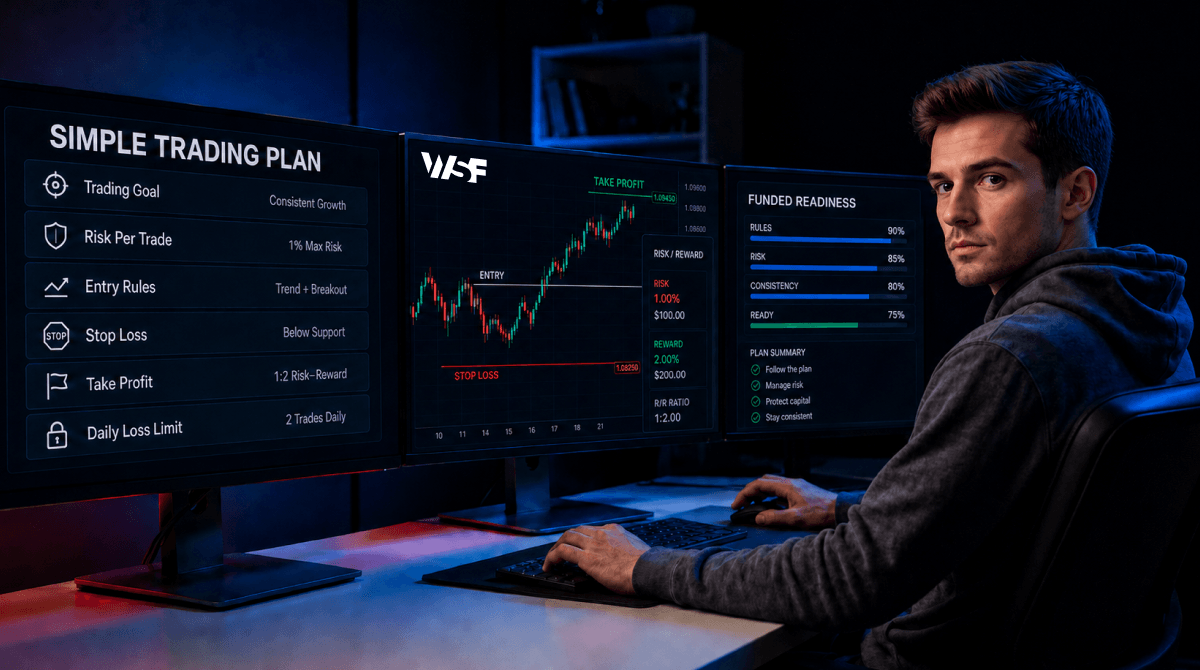
Building a simple trading plan before your funded evaluation is the difference between passing with are pea table process and blowing the challenge on day four with no idea why. Most traders don't fail because they can't read a chart. They fail because they're inventing rules in real time, under pressure, with actual consequences attached. Write the plan first. Test it. Then sit the evaluation.
Why Does a Trading Plan Matter Before You Apply for Funding?
Funded evaluations amplify pressure in ways a demo account simply doesn't. When real consequences attach to every position, small impulsive decisions compound fast, and most traders don't notice until the drawdown is already painful.
A trading plan removes as many in-the-moment choices as possible. Pre-made rules you follow regardless of how the market feels that day replace the kind of reactive decision-making that kills accounts.
Retail traders consistently report making emotionally driven decisions during losing streaks, with no documented rules to fall back on. Without structure, drawdown doesn't just hurt your account. It warps your judgment.
The trading plan becomes your edge when your emotions stop cooperating. Traders who enter evaluations without one often pass individual days but fail the overall challenge because they change their approach mid-run, chasing lost ground with an unfamiliar strategy. Consistency is what prop firms actually measure. Not brilliance. Arriving with a process you've already proven in your own hands is the entire point.
What Does a Simple Trading Plan Actually Include?
Simple does not mean vague. It means stripping out everything that doesn't directly affect your trading decisions.
A working trading plan covers five core components:
- Market focus: The specific instruments you trade (e.g. EUR/USD, gold, GBP/JPY) and why those fit your schedule and skill set
- Session hours: The exact hours you trade, based on when your chosen markets have reliable liquidity
- Entry criteria: The specific conditions that must be present before you open a trade, not general patterns but defined triggers
- Risk per trade: A fixed percentage of account balance you risk on each position, calculated before entry
- Exit rules: Both your stop-loss and your take-profit
One page. That's it. The goal is to make decisions faster under pressure, not to document every trading concept you've absorbed over the years.
How Do You Define Your Trading Strategy and Risk Rules?
Choosing a trading strategy isn't about finding the most sophisticated system available. It's about choosing one you can execute without thinking twice, even when you're second-guessing everything else.
Which Trading Setup Should You Use?
Start with a single entry pattern. A breakout above a key resistance level, a moving average crossover, a price action signal at a defined support zone. Pick one. Running multiple setups simultaneously fragments your attention and makes it nearly impossible to track what's actually working versus what happened to produce a lucky result.
Once you've chosen your pattern, write the exact conditions in plain language.
"Price closes above the 50-period moving average with volume confirmation" is a rule.
"When the market looks bullish" is not.
How Do You Fix Your Risk Parameters?
Risk management is where funded traders either survive or fail. A common starting point is risking0.5% to 1% of your account per trade. On a $100,000 funded account, that means your maximum loss on any single trade sits between $500 and $1,000. Write that number down before you log in.
A key concept here is your risk-to-reward ratio: the relationship between what you're willing to lose and what you're targeting to gain. A 1:2 ratio means risking $500 to target $1,000. Over enough trades, even a 40% win rate produces net profit at that ratio. Run the numbers on your own strategy before assuming it holds up.
Many evaluation challenges also impose daily loss limits and maximum drawdown rules, so your personal risk thresholds need to sit comfortably inside those, with room to spare.
Practical tip: If your strategy has a historical win rate of around 45%, a minimum 1:2 risk-to-reward ratio keeps your expected value positive. Run the numbers on your own strategy before assuming it works.
How Do You Test Your Trading Plan Before It Counts?
Writing a trading plan isthe start. Validating it is the part most traders skip, which is exactly why they struggle when evaluation pressure arrives.
Use a Demo Account
A demo account isn't just for beginners learning how platforms work. It's the correct place to find out whether your plan produces consistent results across a meaningful sample size. Run at least 30 to 50 trades under your exact plan rules before moving into any funded environment. Track every trade in a spreadsheet: entry reason, result, emotional state, and whether you followed your rules or fudged them.
Analyse Trading Plan Results
After your test period, calculate your win rate, average win, average loss, and maximum consecutive losses. Traders who journal consistently show measurably better rule adherence over time compared to those who don't.
Look specifically at your losing trades. Were they losses from following your plan, or losses from breaking it? Plan losses are acceptable. Discipline losses are a signal to fix your behavior before any real capital is involved.
What Do Prop Firms Look for in Funded Traders?
Prop firms are not looking for traders who never lose. Prop firms are looking for traders who manage risk predictably and grow an account within defined rules without taking outsized positions to get there.
Evaluation challenges typically involve hitting a profit target without breaching a daily loss limit or maximum drawdown threshold. The specific rules vary by firm, but the underlying principle is identical everywhere: show that you can generate returns without gambling the account on a single conviction trade.
WSFunded, for example, structures its evaluation around clear, achievable rules with defined profit splits, allowing traders to access firm capital rather than risking their own savings. That model only works for traders who arrive with a pre-existing plan. Attempting an evaluation while still figuring out your strategy wastes the entry fee and, more importantly, the time.
The traders who pass most reliably treat the challenge as a performance review of something they already trust. Your trading plan is the evidence that you've actually done that work.
Conclusion
A simple trading plan is the single most practical step a trader can take before entering any funded evaluation. Traders who arrive with documented rules, tested setups, and fixed risk parameters give prop firms exactly what they're looking for: evidence of are pea table process. Skip the plan and you're not being evaluated on your trading. You're being evaluated on your improvisation. Build the plan first, then sit the challenge.
FAQ
Q1. Do I need a trading plan to pass a funded evaluation?
A. Yes, practically speaking. Evaluation challenges measure consistency and rule adherence over time, not individual winning trades. Without a documented plan, your approach changes under pressure, which typically causes drawdown violations rather than a single catastrophic loss.
Q2. Should I include daily profit targets in my trading plan?
A. A daily profit target can be included, but it should not encourage overtrading. Focusing on consistent execution and controlled risk is generally more useful than trying to reach a fixed profit amount every day.
Q3. What's the most common reason traders fail evaluations?
A. Overtrading and revenge trading after a loss are the most frequently cited failure modes. Both stem directly from having no pre-defined rules for trade frequency or daily loss limits, which a properly built trading plan addresses before the evaluation starts.
Q4. Can I change my trading plan during an evaluation?
A. You can, but it's rarely a good idea. Changing your strategy mid-evaluation introduces untested variables at exactly the wrong time. Make adjustments after the evaluation, not during it, based on what your journal data actually shows.

Explore more blogs



Join our private community


Company Information: WSFmarkets Ltd is a company incorporated under the laws of Saint Lucia, with registration number 2025-00117 and its registered office located at Ground Floor, Rodney Court Building, Rodney Bay, Gros Islet, Saint Lucia.Other Operational Entity Information: Our Cyprus office, RENATICA LTD., located at Arch. Makariou Ill, 228 AGIOS PAVLOS COURT, Block A Floor 1, Office 113, 3030, Limassol, Cyprus to facilitate payment operations related activities for the business.
Regional Restrictions: WSFmarkets Ltd does not offer its services to residents of certain jurisdictions, including but not limited to the United States, Singapore, Russia, the United Arab Emirates (UAE), and any jurisdiction listed by the Financial Action Task Force (FATF) or subject to international sanctions. The information on this website is not intended for distribution to or use by any person or entity in any jurisdiction where such distribution or use would violate local laws or regulations. You must be 18 years old or the legal age of majority in your country of residence to be our client.CFDs with a virtual currency pair as the underlying asset are complex, extremely risky, and generally highly speculative. They carry a high risk of losing all invested capital and are therefore not suitable for all investors. The value of virtual currencies is subject to extreme volatility and may result in significant losses in a short period of time. Clients should not trade CFDs with a virtual currency pair as the underlying asset unless they possess the necessary knowledge of this specific product or are able to bear the total loss of the invested capital. For more information, please refer to the Risk Warnings and Disclosures.
General Disclaimer
WSF Technology FZCO, located at Building A1, Dubai Digital Park, Dubai Silicon Oasis, Dubai, United Arab Emirates, and operating under License No. 47001, declares that it is not a broker, is not an investment manager, and does not act as a regulated financial entity under the laws of the European Union, MiFID II, ESMA, the SEC, the CFTC, the DFSA, or any other international regulatory authority.The company does not execute, transmit, or send orders to any market, broker, or liquidity provider, and all trading activity carried out by users within its programs is strictly simulated, involving no real capital and providing no access to real financial markets.
The company does not provide portfolio management, financial advisory services, investment recommendations, trading signals, or any activity associated with regulated investment services, nor does it solicit, raise, or manage investor capital.
Its services are strictly limited to evaluation programs and simulated trading activities designed to assess participant performance without generating real financial exposure. Although WSF Technology FZCO is not regulated as a broker or investment firm, it voluntarily applies high standards of transparency, user protection, conflict-of-interest management, and data-privacy compliance, including GDPR for users located in the European Union.
