

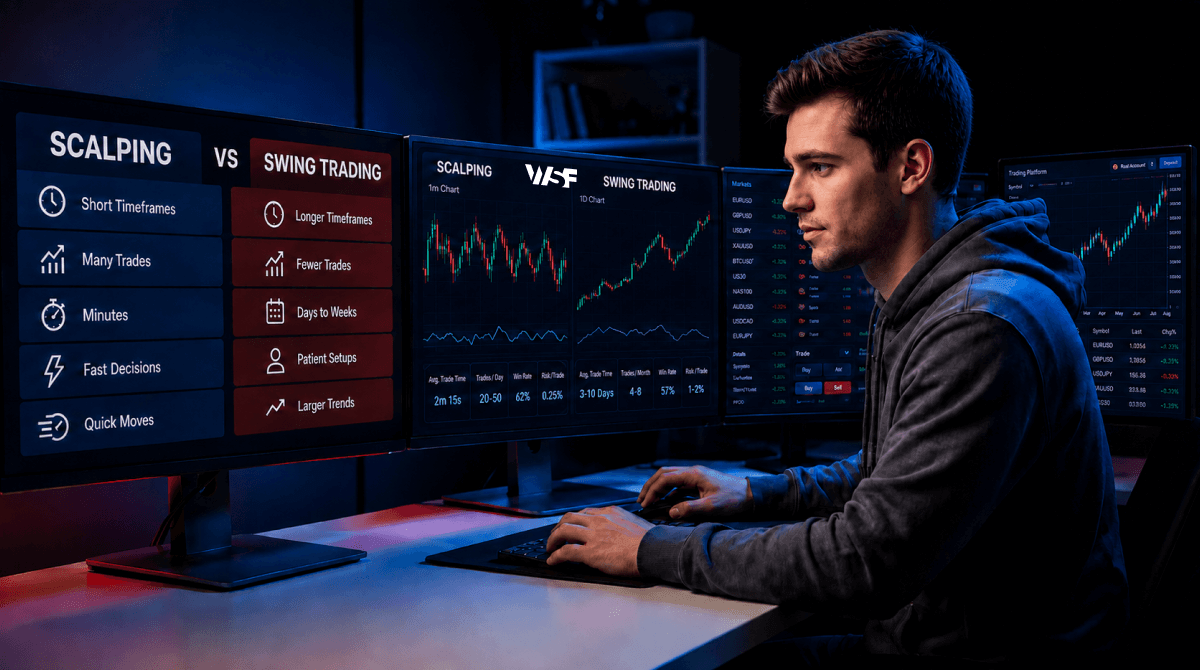
Scalping or Swing Trading: Choosing the Right Strategy for Funded Accounts

Explore more blogs
Fintech has the potential to promote financial inclusion. In many parts of the world, millions of people lack access to traditional banking services.


Join our private community
Access exclusive offers, news, trading tips, and a global network of traders to share ideas, resolve doubts, and stay up-to-date.


Simulated Trading Environment: All accounts offered by WSFmarkets Ltd, under WSF Technology FZCO, are not real trading accounts. The company does not manage client funds, does not hold or safeguard third-party money, and does not provide access to regulated financial instruments; therefore, any balance, profit, loss, or account displayed on its platforms is entirely hypothetical and part of a simulated environment.
Company Information: WSFmarkets Ltd is a company incorporated under the laws of Saint Lucia, with registration number 2025-00117 and its registered office located at Ground Floor, Rodney Court Building, Rodney Bay, Gros Islet, Saint Lucia.Other Operational Entity Information: Our Cyprus office, RENATICA LTD., located at Arch. Makariou Ill, 228 AGIOS PAVLOS COURT, Block A Floor 1, Office 113, 3030, Limassol, Cyprus to facilitate payment operations related activities for the business.
Regional Restrictions: WSFmarkets Ltd does not offer its services to residents of certain jurisdictions, including but not limited to the United States, Singapore, Russia, the United Arab Emirates (UAE), and any jurisdiction listed by the Financial Action Task Force (FATF) or subject to international sanctions. The information on this website is not intended for distribution to or use by any person or entity in any jurisdiction where such distribution or use would violate local laws or regulations. You must be 18 years old or the legal age of majority in your country of residence to be our client.CFDs with a virtual currency pair as the underlying asset are complex, extremely risky, and generally highly speculative. They carry a high risk of losing all invested capital and are therefore not suitable for all investors. The value of virtual currencies is subject to extreme volatility and may result in significant losses in a short period of time. Clients should not trade CFDs with a virtual currency pair as the underlying asset unless they possess the necessary knowledge of this specific product or are able to bear the total loss of the invested capital. For more information, please refer to the Risk Warnings and Disclosures.
General Disclaimer
WSF Technology FZCO, located at Building A1, Dubai Digital Park, Dubai Silicon Oasis, Dubai, United Arab Emirates, and operating under License No. 47001, declares that it is not a broker, is not an investment manager, and does not act as a regulated financial entity under the laws of the European Union, MiFID II, ESMA, the SEC, the CFTC, the DFSA, or any other international regulatory authority.The company does not execute, transmit, or send orders to any market, broker, or liquidity provider, and all trading activity carried out by users within its programs is strictly simulated, involving no real capital and providing no access to real financial markets.
The company does not provide portfolio management, financial advisory services, investment recommendations, trading signals, or any activity associated with regulated investment services, nor does it solicit, raise, or manage investor capital.
Its services are strictly limited to evaluation programs and simulated trading activities designed to assess participant performance without generating real financial exposure. Although WSF Technology FZCO is not regulated as a broker or investment firm, it voluntarily applies high standards of transparency, user protection, conflict-of-interest management, and data-privacy compliance, including GDPR for users located in the European Union.
Company Information: WSFmarkets Ltd is a company incorporated under the laws of Saint Lucia, with registration number 2025-00117 and its registered office located at Ground Floor, Rodney Court Building, Rodney Bay, Gros Islet, Saint Lucia.Other Operational Entity Information: Our Cyprus office, RENATICA LTD., located at Arch. Makariou Ill, 228 AGIOS PAVLOS COURT, Block A Floor 1, Office 113, 3030, Limassol, Cyprus to facilitate payment operations related activities for the business.
Regional Restrictions: WSFmarkets Ltd does not offer its services to residents of certain jurisdictions, including but not limited to the United States, Singapore, Russia, the United Arab Emirates (UAE), and any jurisdiction listed by the Financial Action Task Force (FATF) or subject to international sanctions. The information on this website is not intended for distribution to or use by any person or entity in any jurisdiction where such distribution or use would violate local laws or regulations. You must be 18 years old or the legal age of majority in your country of residence to be our client.CFDs with a virtual currency pair as the underlying asset are complex, extremely risky, and generally highly speculative. They carry a high risk of losing all invested capital and are therefore not suitable for all investors. The value of virtual currencies is subject to extreme volatility and may result in significant losses in a short period of time. Clients should not trade CFDs with a virtual currency pair as the underlying asset unless they possess the necessary knowledge of this specific product or are able to bear the total loss of the invested capital. For more information, please refer to the Risk Warnings and Disclosures.
General Disclaimer
WSF Technology FZCO, located at Building A1, Dubai Digital Park, Dubai Silicon Oasis, Dubai, United Arab Emirates, and operating under License No. 47001, declares that it is not a broker, is not an investment manager, and does not act as a regulated financial entity under the laws of the European Union, MiFID II, ESMA, the SEC, the CFTC, the DFSA, or any other international regulatory authority.The company does not execute, transmit, or send orders to any market, broker, or liquidity provider, and all trading activity carried out by users within its programs is strictly simulated, involving no real capital and providing no access to real financial markets.
The company does not provide portfolio management, financial advisory services, investment recommendations, trading signals, or any activity associated with regulated investment services, nor does it solicit, raise, or manage investor capital.
Its services are strictly limited to evaluation programs and simulated trading activities designed to assess participant performance without generating real financial exposure. Although WSF Technology FZCO is not regulated as a broker or investment firm, it voluntarily applies high standards of transparency, user protection, conflict-of-interest management, and data-privacy compliance, including GDPR for users located in the European Union.
