A trader can be in profit and still be close to violating a prop firm's drawdown rule.
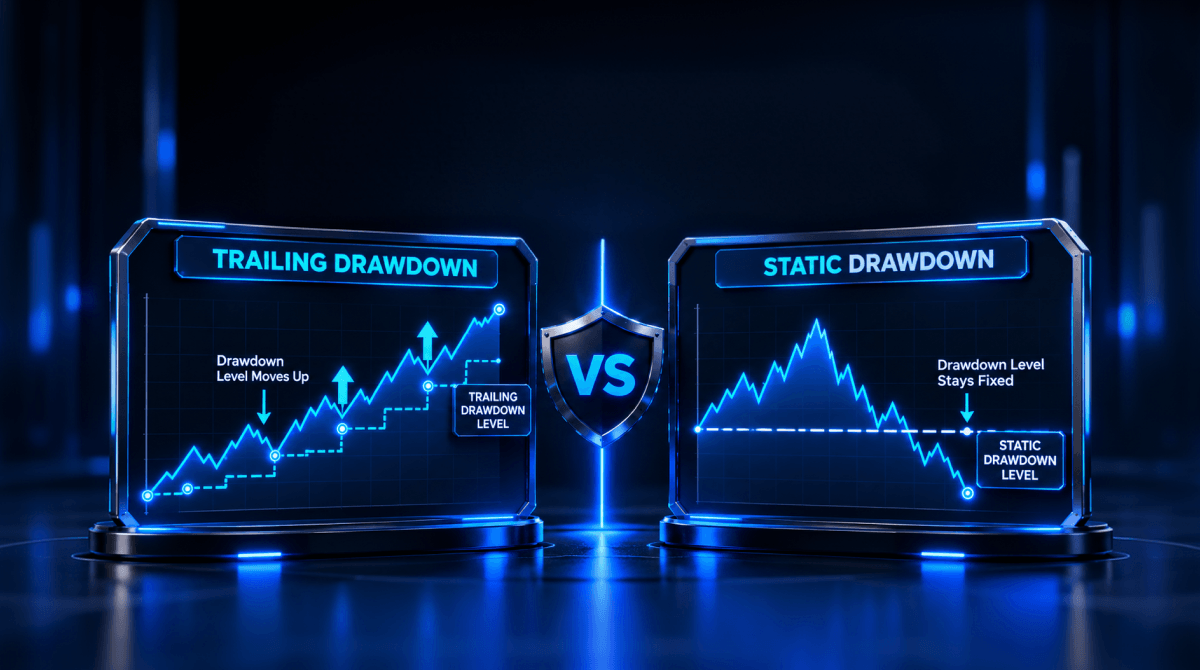
The reason is simple: drawdown can be calculated in different ways. A static drawdown keeps the loss threshold fixed. A trailing drawdown moves the threshold upward as the account reaches new highs.
That difference can change how much room a trader has after making profits, how open positions are treated, and how risk should be managed.
Before choosing a prop trading challenge, understanding the drawdown model can be just as important as checking the profit target.
Static drawdown is a fixed loss limit based on a starting account value. The threshold does not move when the account makes a profit.
For example, assume a $50,000 account has a 10% static maximum drawdown.
If the account later grows to $55,000, the drawdown threshold remains $45,000.
The trader therefore has a larger gap between the current account value and the fixed loss threshold.
WSFunded uses static maximum drawdown on several of its challenge models. Its Classic model, for example, lists an 8% static maximum drawdown, while its Rapid model lists a 6% static maximum drawdown.
The exact percentage and other rules depend on the account model.
Trailing drawdown is a loss limit that moves upward as the account reaches new balance or equity highs.
Consider a $50,000 account with a $2,500 trailing drawdown:
| Account Peak | Trailing Loss Limit | Breach Level |
|---|---|---|
| $50,000 | $2,500 | $47,500 |
| $51,000 | $2,500 | $48,500 |
| $52,000 | $2,500 | $49,500 |
| $53,000 | $2,500 | $50,500 |
The important difference is that the floor moves upward after a new high. It does not move back down when the account loses money.
The exact calculation can differ between firms. Some use balance, while others use equity. Some update the threshold during the trading session, while others update it at a defined time.
At WSFunded, our Instant Standard model uses a 6% trailing maximum loss, with the threshold following the highest balance or equity reached by the account.
The basic difference can be seen clearly in the table below:
| Factor | Static Drawdown | Trailing Drawdown |
|---|---|---|
| Starting reference | Initial account balance | Account's highest qualifying balance or equity |
| Loss threshold | Fixed | Moves upward |
| Changes after profit | No | Yes |
| Moves downward after losses | No | No |
| Profit can increase the threshold | No | Yes |
| Main point to check | Fixed breach level | How the trailing level is calculated |
The percentage alone does not tell the whole story.
Two accounts can both advertise a 6% maximum drawdown but provide different amounts of usable room depending on how the threshold is calculated.
Static drawdown remains tied to the original account value.
Suppose a trader starts with $100,000 and has a 10% static maximum drawdown.
The fixed breach level is $90,000.
If the trader grows the account to $110,000, the same $90,000 threshold remains in place.
If the account then falls to $105,000, the trader has given back $5,000 but remains $15,000 above the original drawdown floor.
The account's profit has created additional distance from the fixed threshold.
That does not mean the trader should increase position size. Other rules, such as daily loss limits or maximum risk per trading idea, may still apply.
Trailing drawdown works differently because the threshold follows the account upward.
Suppose a $100,000 account has a $5,000 trailing drawdown.
The starting breach level is $95,000.
If the account reaches $103,000, the threshold may move to $98,000 if the firm's rule trails the qualifying peak by $5,000.
If the account then falls to $98,000, the trader can reach the drawdown limit even though the account remains above its original $100,000 starting balance.
This is one of the main points traders miss when reading a trailing drawdown rule.
An account can remain profitable relative to its starting balance while still reaching its trailing loss threshold.
Trailing drawdown does not describe one identical calculation across every prop firm. A trader should find out what the threshold follows.
In Balance-based trailing drawdown the threshold changes according to the account balance, generally after trades close.
In Equity-based trailing drawdown the calculation can include unrealised profit or loss from open positions.
This can matter during a trade. An open position that temporarily reaches a new equity high may affect the trailing threshold under rules that track equity.
Some programs update the threshold at a specified daily time rather than continuously throughout the session.
These differences can produce very different results from the same sequence of trades. Prop trading guides commonly distinguish static, intraday trailing, and end-of-day trailing structures for this reason.
Consider a $50,000 account with a $2,500 drawdown allowance.
The trader makes $2,000, taking the account to $52,000. The account then gives back $1,500 and falls to $50,500.
With a static $2,500 drawdown:
With a trailing $2,500 drawdown based on the $52,000 peak:
The trade sequence is identical. The available room is different because the reference point changed.
This is why traders should calculate the actual breach level rather than comparing drawdown percentages alone.
Drawdown should be considered before entering a trade, rather than only after a loss occurs.
For a static account, the fixed breach level is relatively easy to calculate.
For a trailing account, traders also need to track the current trailing threshold. A new account high can change the amount of room available.
For example, if the trailing floor moves from $48,000 to $49,000, the trader now has $1,000 less room before reaching the threshold, assuming the current account value remains unchanged.
This makes position sizing particularly important after a strong run of profitable trades.
WSFunded uses both structures, depending on the account model.
Our current Instant Standard account has a 6% trailing maximum loss. The threshold follows the maximum balance or equity reached by the account.
Our Classic account uses an 8% static maximum drawdown, while Rapid uses a 6% static maximum drawdown.
WSFunded's Elite New model also lists a static maximum drawdown and no daily drawdown.
There is no single rule structure that works the same way for every trading approach.
A trader who tends to hold positions through larger pullbacks may need to pay close attention to how an equity-based trailing rule treats open profit and loss.
A trader using shorter holding periods may focus more on how quickly the trailing threshold moves after new highs.
For either structure, the right comparison starts with the actual calculation method, breach level, daily loss rule, and trading restrictions.
Trailing and static drawdown can produce very different trading conditions even when the advertised percentage looks similar.
Static drawdown keeps the floor fixed. Trailing drawdown moves the floor upward as the account reaches new highs.
Before choosing a prop trading program, read how the firm calculates that floor and how it interacts with daily loss limits, open positions, and other account rules.
Static drawdown keeps the loss threshold fixed from the starting balance. Trailing drawdown raises the threshold as the account reaches new qualifying highs.
No. A static drawdown threshold remains fixed according to its defined starting reference.
It depends on the firm's rules. Some trailing systems track equity, which includes unrealised profit and loss, while others use balance.
Yes. WSFunded's Classic model, for example, lists a static maximum drawdown alongside a separate daily drawdown limit.
Check the starting reference, calculation method, update frequency, treatment of open positions, breach level, daily loss rule, and whether the threshold changes after payouts.